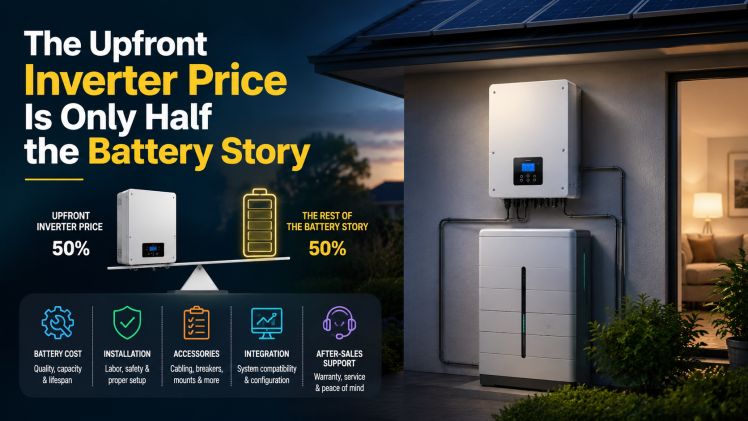
Two solar quotes can look almost identical until the inverter line appears. One uses a string inverter. The other uses microinverters and costs more up front. For a homeowner who plans to add a battery in two or three years, that price gap is only the beginning of the conversation.
A cheap inverter can become an expensive system path
Microinverters convert DC power to AC at each solar panel. A string inverter sends DC power from a group of panels to one inverter, where the conversion happens. Both can power a good residential solar system. The trouble starts when a solar-only quote is judged without thinking about storage, backup, EV charging, or future electrical upgrades.
According to the IEA, residential battery adoption is growing as households look for more self-consumption and resilience. That trend changes how inverter choices should be judged. A system that looks cheapest on day one may need extra hardware later if the homeowner wants backup power, battery control, or smarter energy scheduling.
This is why some buyers compare inverter quotes alongside an integrated storage path like Sigenergy’s SigenStor system, which combines solar inverter, EV DC charging capability, battery PCS, battery pack, and energy management in one platform.
Cost is not only equipment cost
Homeowners usually focus on the visible numbers: inverter price, panel price, battery price, and installation labor. Those matter, but they are not the whole picture. The hidden costs often show up in system design.
Useful cost questions include:
· Will the system support a battery without major rewiring?
· Can it prioritize solar self-use during high utility rates?
· Does the monitoring app show enough detail to guide behavior?
· Is the backup design already planned, or will it be a separate project?
· Can EV charging fit into the same energy plan later?
A microinverter system can be attractive for complicated roofs and panel-level monitoring. A string or hybrid architecture can be attractive when storage is central to the plan. The right answer depends on whether the home is buying solar as a standalone project or as the first step toward a managed energy system.
Battery plans should shape the first quote
Battery storage changes the solar conversation because it shifts the goal from “generate kilowatt-hours” to “use the right kilowatt-hours at the right time.” A home on time-of-use rates may want to store midday solar and use it in the evening. A home with outage concerns may care more about which circuits stay on when the grid fails.
According to the U.S. Energy Information Administration, time-of-use and demand-based pricing structures are increasingly part of utility rate design in many markets. That means controls and scheduling can matter nearly as much as generation.
That is where an AI-powered home energy storage setup can make a cost comparison more realistic. It gives the homeowner a way to think about solar, battery storage, EV charging, and energy management as one project rather than a chain of add-ons.
The best buying move is to ask for two versions of the proposal: solar-only and solar-plus-storage-ready. If the installer cannot explain what changes later, the cheapest inverter quote may not be the cheapest path.
For homeowners who already expect to add a battery, SigenStor is worth comparing against a pieced-together upgrade plan before the first inverter decision is locked in.